
Innovation
Many men and women of St Andrews made crucial developments to countess fields that greatly impact the modern world. From the Lenticular telescope to the first Meridian Line, explore the many innovations made in our town!
After reading the information below, use our innovation quiz to see what you can remember.
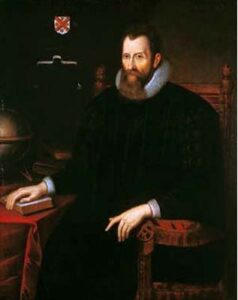
John Napier (1550-1617), was a Scottish landowner, mathematician, physicist, astronomer, and discoverer of logarithms. He is credited with the invention of the so-called ‘Napier’s bones’ (a calculating device) and made common the use of the decimal point.
show moreHe was enrolled in St Salvator’s College in the University of St Andrews at the age of 13, and it is suspected that he left Scotland to further his education in mainland Europe.
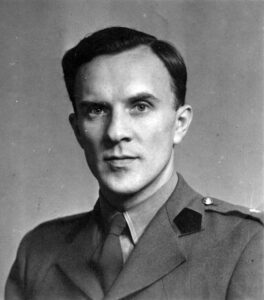
Lieutenant Józef Stainisław Kosacki was a Polish army officer and inventor of the worlds first landmine detector.
show moreAfter feeling Poland, and later France, he joined the remnants of the Polish armed forces on the East coast of Scotland. While stationed in St Andrews, he designed, tested, and refined his landmine detector in response to a competition run by the British army for the development of such a device. His innovation was blew away the competition and has saved countless lives since its first use in 1941.
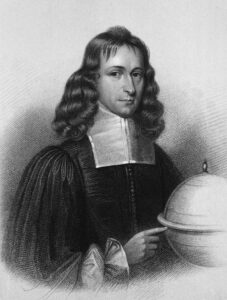
James Gregory (1638-1675) was a Scottish mathematician, astronomer, and first Regius Professor of Mathematics at the University of St Andrews.
show moreHe was the first to state and prove a version of the Fundamental Theorem of Calculus and was the first to write a textbook concerning Calculus, which is why calculus was taught at St Andrews a hundred years before it was on the curriculum at the University of Cambridge.
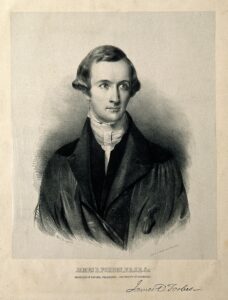
James David Forbes (1809-1868) was principal at the University of St Andrews from 1859 to his death in 1868. He studied the contradictory topics of heat and glaciers.
show moreWhile he was principal of the University of St Andrews, he oversaw many projects such as the restoration of St Salvator’s Chapel and the reorganisation of United College finances. Similarly, he made important reforms at the University of Edinburgh during his time there as professor of natural philosophy.
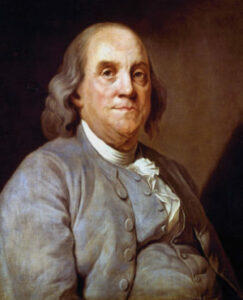
Founding Father of the United States of America, Benjamin Franklin (1706-1790), excelled in numerous fields owing to his vast interests. His contributions to the American Revolution and the building of a new nation were only one part of a highly distinguished career.
show moreIn his 84 years he was a printer, a postmaster, an ambassador, an author, a scientist, a philosopher, a writer, a statesman and, above all, an inventor. By the age of 11, he was inventing solutions to common problems, including a ‘Long Arm’ to grab books from the top shelf and swimming fins to help him swim more easily.
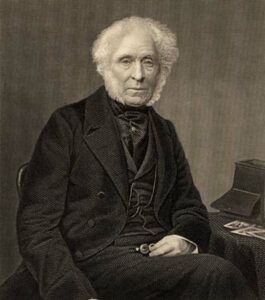
David Brewster (1781-1868) was principal of the United Colleges of St Salvador and St Leonard at the University of St Andrews from 1837-1859. Whilst here in 1849, he completed one of his most popularising achievements; the development of a more practical stereoscope than the existing model, enabling viewing of images in 3D.
show moreIn St Andrews, Brewster experimented eagerly to refine photographic techniques. Among others, he developed the “lenticular stereoscope”, which was more practical than that invented by Charles Wheatstone. Stereoscopes create the illusion of a 3D image, using understanding of the human ability to see two different perspectives with each eye. The fusion of these images is crucial for our spatial perception.
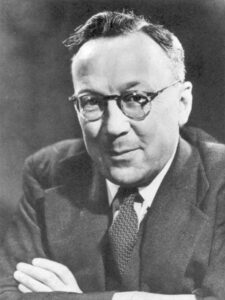
Sir Robert Watson-Watt was a Scottish engineer and the inventor of radar. His work led to the survival of the RAF during the Battle of Britain and to eventual German defeat.
show moreBorn in Brechin, Angus, in 1892, Watson-Watt studied for a degree in engineering from University College, Dundee, then part of the University of St Andrews. After graduation, he went to work for the Meteorological Office, and in 1935 began the development of what today we refer to as radar. He successfully demonstrated its effectiveness in detecting aircraft, and soon a network of radar stations dotted the UK coastline. His invention may have been the deciding factor in Britain surviving the German onslaught by air during the Battle of Britain in 1940.
Sir James Whyte Black was a Scottish pharmacologist, and the only graduate from the University of St Andrews that holds a Nobel prize. His exceptional research on pharmacy led him to develop 2 very famous drugs for pain and disorder management in the human heart and stomach.
show moreBlack earned his degree in 1946, and a few years later, in 1950 he founded a physiology department at the University of Glasgow Veterinary School. He continued to teach in other universities until 1958, when he joined the Imperial Chemical Industries, working as a senior pharmacologist.
show less